
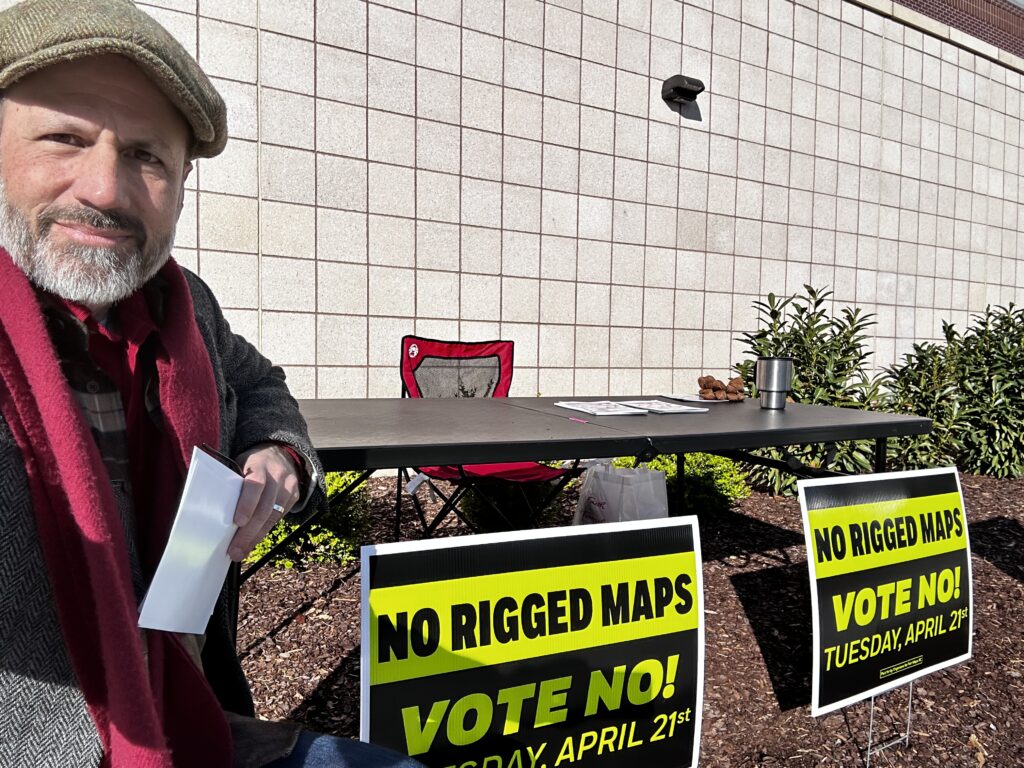
The time has come for a frank discussion — a conversation about what we mean when we say “self-government.” A talk about when it exists, and about when it does not.
The United States were founded as a self-governing nation. Our Declaration of Independence states plainly that governments derive their just powers from the consent of the governed. Some rights are inherent — they exist apart from government authority, regardless of whether government affirms them. Others are political — they may change, based upon the laws of the land and the decisions of governments.
Among the most fundamental of political rights is this: the right to have your prior acts of self-governance respected. The right to know that what you painstakingly encoded into your constitution will not be casually undone the moment a temporary majority finds it inconvenient.
In Virginia on Tuesday, April 21, that right was violated.
The People Had Already Spoken — With a Supermajority
The story does not begin on Election Day. It begins in November 2020, when Virginia voters approved a constitutional amendment creating a bipartisan redistricting commission — with 66% of the vote.
That is not a bare majority. That is a supermajority — two-thirds of Virginians, across party lines, encoding their considered judgment into the highest law of the Commonwealth. Constitutional protections are meant to be durable. They are meant to withstand the pressures of the moment. That is the entire point of a constitution.
Tuesday’s referendum did not represent the people overriding their politicians. It represented one party’s politicians carefully engineering a process to override the people’s own constitution — and then winning a narrow popular vote to ratify that override. With approximately 95% of votes counted, roughly 51.4% of voters had voted yes. A bare majority in a single election does not supersede a supermajority constitutional mandate. Not morally. Not philosophically. And quite possibly not legally.
The Process Was Ruled Unlawful — Repeatedly
The victory being celebrated today was achieved over the explicit objections of Virginia’s own judiciary. As Fox News reported, the redistricting amendment was struck down by Judge Jack S. Hurley Jr., who ruled that lawmakers violated constitutional requirements and overstepped their authority, ordering that any such action is “void, ab initio” — invalid from the very start.
The Washington Examiner detailed the breadth of that ruling: Judge Hurley found that the Democrat-led legislature failed to follow multiple procedures required to place the measure on the ballot — including a requirement that the proposed amendment be posted on courthouse doors and published by the House clerk three months before the next House election, a notice provision designed specifically to ensure voters are informed before electing the legislators who cast the constitutionally required second vote on any amendment.
That ruling was appealed. Democrats pressed forward. A second court intervened on entirely separate grounds and issued another injunction. Democrats appealed again. The Virginia Supreme Court then made an extraordinary choice: to allow the vote to proceed while deferring its final ruling until after the ballots were counted. The legal battle is not over.
What Disenfranchisement Actually Means
Democrats have built much of their political identity around the word disenfranchisement, invoking it readily, loudly, and at every opportunity. It is therefore worth applying the word with precision to what they have done.
When the people amend their constitution by supermajority, that provision is the popular will — not the fleeting will of a single moment, but the considered, durable judgment of the governed. To circumvent it through a process two courts found unlawful, rushed to a vote before those courts could render final judgment, and funded by nearly $100 million — much of it from dark money groups whose donors the public has no right to know — is to disenfranchise every Virginian who cast that 2020 vote. It is to tell two-thirds of the people that their most solemn civic act can be undone by a bare majority if the right party controls the legislature at the right moment.
Tellingly, even voices from the winning side acknowledged the legal clouds. NPR reported that Jason Miyares and Eric Cantor, co-chairs of Virginians for Fair Maps, stated after the vote: “Virginians disenfranchised by today’s vote will have their day in court.” The word disenfranchised is theirs. It is the right word.
The Principle at Stake — And What Comes After
The constitution is not an obstacle to democracy. It is democracy — the deep, considered, supermajority voice of the people, speaking across time. No bare majority, however well-funded or loudly celebrated, is above the rules by which a free people agreed to govern themselves.
The Virginia Supreme Court has already made one remarkable choice in this saga: allowing an election to proceed on a measure two lower court judges independently declared unlawful, and deferring judgment until after the votes were counted. A court that will not protect the constitution before the damage is done has already tilted the playing field. The majority has been manufactured. The pressure has been applied. The political cost of reversal has been maximized.
Let it therefore be stated plainly: if any Virginia court ultimately ratifies what two of its own judges called unlawful — if it finds that a process declared void ab initio is somehow valid after all — then it will not have settled the question. It will only have escalated it. The people’s indignation will be legitimate, it will be durable, and it will be directed not only at the politicians who engineered this outcome, but at every judicial officer who chose to look the other way.
Courts derive their authority from the consent of the governed. That consent is not unconditional.
We will be watching.